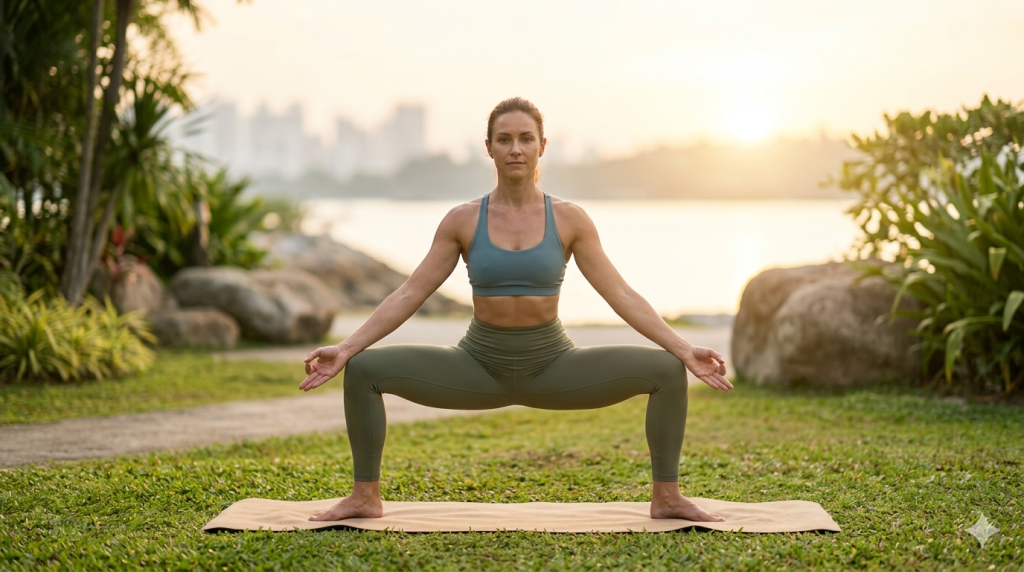
If you feel like your morning routine is missing a spark, or your current yoga practice has plateaued, the solution might be simpler than a complex flow. While many practitioners focus on the flow of Vinyasa or the flexibility of Yin, there is a fundamental posture often overlooked in modern studio classes that bridges the gap between stability and raw power: the Goddess Pose (Utkata Konasana).
Often sidelined in favor of Warrior II or Chair Pose, Goddess Pose is a powerhouse move that targets the lower body, opens the hips, and builds the kind of functional strength that carries you through a demanding day. Incorporating this into your morning ritual can shift your physiology from sluggish to energized in just a few breaths.
Why Your Yoga Class Might Be Missing This Move
In the fast-paced environment of many yoga studios, instructors often prioritize linear movements—moving forward and backward on the mat. Goddess Pose requires a lateral (sideways) opening that challenges the adductors and the deep stabilizers of the pelvis. Because it requires significant hip mobility and sustained muscular endurance, it is sometimes swapped for “easier” transitions.
However, by skipping this pose, you miss out on a unique opportunity to build “concentric” heat. Unlike poses that focus purely on stretching, Goddess Pose demands that your muscles fire intensely while in a lengthened state. This creates a stable foundation for the spine and improves posture almost immediately.
The Anatomy of Strength and Stability
To understand why this pose is a “must-do,” we have to look at the muscle groups involved. When you sink into a wide-legged squat with your toes turned out, you are engaging:
The Quadriceps and Glutes: These are the largest muscle groups in the body. Activating them early in the morning boosts metabolism and signals the nervous system to wake up.
The Adductors (Inner Thighs): These muscles are often weak in runners and walkers. Strengthening them provides better support for the knee joints.
The Core and Pelvic Floor: Maintaining an upright torso in this pose requires deep core integration, which protects the lower back.
The Scapular Stabilizers: When you bring your arms into “cactus” position, you engage the muscles between your shoulder blades, countering the “slump” caused by sitting at desks or looking at phones.
How to Practice Goddess Pose for Maximum Energy
The Setup: Stand sideways on your mat with your feet about three to four feet apart. Turn your toes out toward the corners of the mat at a 45-degree angle.
The Descent: As you exhale, bend your knees deeply. Aim to get your thighs parallel to the floor, but stay at a height where you can maintain a neutral spine. Ensure your knees are tracking over your toes and not caving inward.
The Upper Body: Tuck your tailbone slightly to engage your lower abdominals. Reach your arms out to the sides at shoulder height, then bend your elbows to 90 degrees with palms facing forward (Cactus Arms).
The Breath: This is the “energy” component. Instead of shallow chest breathing, focus on deep diaphragmatic breaths. Feel your ribs expand 360 degrees.
The Hold: Start with 30 seconds. As you build stamina, move toward 60 or 90 seconds. The “heat” you feel in your legs is your body building resilience.
Scaling Your Practice: From Beginner to Advanced
The beauty of the Goddess Pose is its versatility. If you are just starting, you can keep your hands on your hips or even use a wall for balance. If you are looking to push your limits, try lifting your heels off the floor one at a time—or both at once—to challenge your balance and engage your calves.
For an added “energy” boost, incorporate dynamic movement. Inhale as you straighten your legs and reach your arms to the sky (Star Pose), then exhale forcefully as you sink back into Goddess. This rhythmic movement oxygenates the blood and provides a natural caffeine-free wake-up call.
The Mental Edge: Stability Beyond the Mat
Yoga is as much a mental discipline as a physical one. Holding a challenging pose like Goddess requires “Tapas”—the yogic concept of disciplined heat or friction. When your legs begin to shake, your mind’s first instinct is to quit. By staying calm and breathing through the discomfort, you train your brain to handle stress with composure.
This mental stability is exactly what you need when a work deadline looms or a personal situation becomes heated. You learn that you can be “uncomfortable” and “stable” at the same time.
Integrating the Move into a Busy Lifestyle
You don’t need a 60-minute session to reap these benefits. This pose can be done in the kitchen while waiting for coffee to brew or in a hotel room while traveling. Because it targets so many areas at once, it is the ultimate “high-ROI” (Return on Investment) exercise.
Consistency is more important than duration. Doing two minutes of Goddess Pose every morning for a week will yield better results for your stability and energy levels than a single long yoga class once a month.
Conclusion and Practical FAQ
Whether you are an athlete looking to protect your joints or someone seeking a more vibrant start to their day, the Goddess Pose offers a comprehensive solution. It builds the physical strength to move through the world with ease and the mental stability to face any challenge.
FAQ
Q: Is Goddess Pose safe for people with knee pain? A: Yes, but with modifications. Do not sink as deep into the squat, and ensure your knees are pointed in the same direction as your toes. If pain persists, reduce the width of your stance.
Q: Why do I feel shaky when holding this pose? A: Shaking is a natural sign that your muscles are reaching fatigue and your nervous system is adapting to a new load. It is a sign of growth! Just ensure your form remains correct.
Q: Can I do this pose at night? A: While it’s great for morning energy, doing it at night can help release hip tension from a day of sitting. However, focus on a shallower squat and slower breaths to avoid over-stimulating yourself before bed.
Q: What if I can’t keep my back straight? A: This usually indicates tight hips or a weak core. Try widening your stance or not squatting as low until your mobility improves. You can also keep your hands on your thighs for extra support.