In the fast-paced world of 2026, the biggest barrier to fitness is no longer a lack of high-end equipment, but a lack of time. According to the latest fitness trend reports from Fit&Well, a major shift is occurring in households across the United States: the rise of “Micro-Workouts.”
No longer requiring hours-long sessions at a commercial gym, a new movement has proven that with just one set of dumbbells and 15 minutes, you can effectively build muscle, increase strength, and optimize your metabolism.
The Science Behind the 15-Minute Efficiency
Many skeptics ask: “Is 15 minutes really enough?” The answer lies in the intensity and the selection of movements. Instead of isolating small muscle groups, this method focuses on Compound Exercises.
1. Maximum Muscle Fiber Activation
Multi-joint movements like Squats, Presses, and Rows require multiple muscle groups to work simultaneously. This not only burns more calories in a shorter window but also triggers the body’s natural release of growth-promoting hormones.
2. The Afterburn Effect (EPOC)
When you train at a high intensity for 15 minutes, your body enters a state of Excess Post-exercise Oxygen Consumption (EPOC). This means your body continues to incinerate fat long after you’ve sat down at your desk or gone to sleep.
3. Psychological Sustainability
The leading reason Americans quit fitness plans is burnout. Committing to 15 minutes a day is far more manageable than 60 minutes. Consistency is the true key to body transformation, and 15 minutes is the “sweet spot” for maintaining a lifelong habit.
The Total-Body Muscle Building Roadmap
To achieve maximum results in minimum time, the workout must be structured as a Circuit. Here is the 15-minute routine recommended by US fitness experts:
Phase 1: Dynamic Warm-up (2 Minutes)
Never skip this. Perform light arm circles, leg swings, and jumping jacks to prep your muscle fibers and lubricate your joints.
Phase 2: The Main Circuit (12 Minutes)
Perform each move for 45 seconds, followed by 15 seconds of rest. Repeat the entire circuit for 3 rounds.
Dumbbell Thrusters: A combination of a squat and an overhead press. This hits everything from your calves and glutes to your shoulders and triceps. It is the ultimate move for spiking the heart rate.
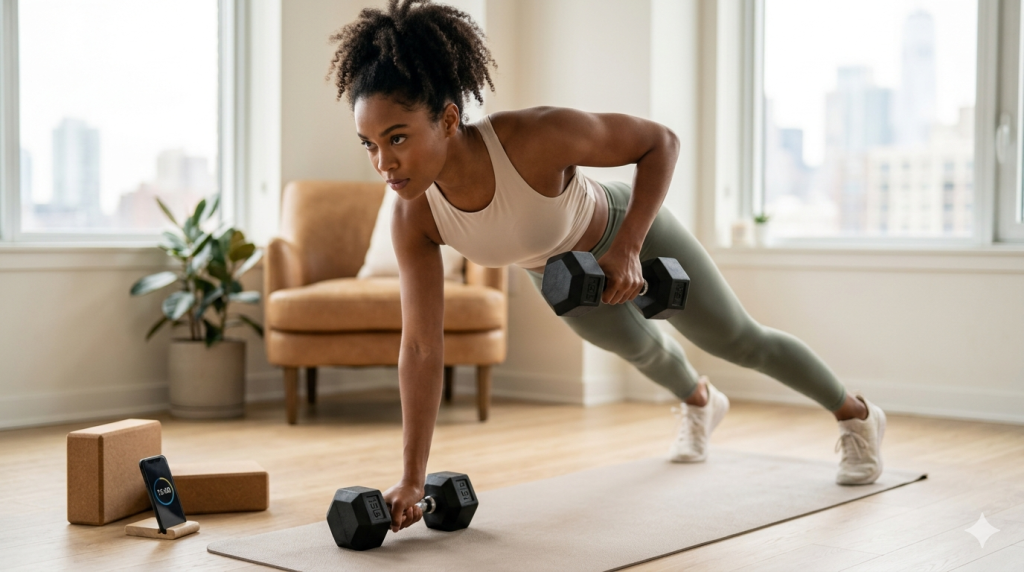
Renegade Rows: From a plank position on your dumbbells, row one weight at a time. This builds a thick back while putting your core stability to the ultimate test.
Goblet Lunges: Hold one dumbbell at chest height and step back into a lunge. This focuses on the quads and balance.
Dumbbell Floor Press: The perfect alternative to the bench press if you don’t have a weight bench. This builds thicker chest muscles and triceps.
Phase 3: Cool Down & Mobility (1 Minute)
Release tension with basic stretches to reduce Delayed Onset Muscle Soreness (DOMS) the next day.
Why This Trend is Dominating Google Discover News in 2026
The reason 15-minute dumbbell workouts are headlining health news in the US is because they solve the “Wellness-Efficiency” puzzle.
Absolute Versatility: You can train in your living room, office, or even a hotel room while traveling for business.
Cost-Effectiveness: In today’s economy, investing in one high-quality set of dumbbells provides a lifetime of value compared to monthly gym memberships.
Scalability: Whether you are a beginner with 5lb weights or an advanced lifter with 50lb weights, the structure of the workout remains effective.
Conclusion: Strength is in Your Hands
15 minutes can be spent scrolling aimlessly on social media, or it can be the time that completely transforms your health and physique. The dumbbell revolution has proven that fitness success doesn’t come from expensive machines, but from the discipline found in the shortest windows of time. Pick up the weights, dedicate 15 minutes to yourself, and feel the difference of a stronger body every day.
Frequently Asked Questions (FAQ)
1. How heavy should my dumbbells be for this 15-minute workout?
For beginners, women typically start with 5–10 lbs, and men with 10–20 lbs. The goal is to choose a weight where you feel muscle fatigue in the last 5 seconds of the interval while maintaining perfect form.
2. Should I do this every day?
Because this is a high-intensity full-body workout, 3–4 sessions per week is optimal. Give your muscles at least one day of rest between sessions to recover and grow.
3. Can a 15-minute workout really help with weight loss?
Yes. This routine combines strength training and cardio, which is highly effective for calorie burning. However, for significant weight loss, it must be paired with a healthy diet and a calorie deficit.
4. What if I don’t own dumbbells?
You can start with two large water bottles or any heavy household objects that are easy to grip. However, investing in a proper set of dumbbells with good grip is safer and more effective in the long run.
5. Is it better to workout in the morning or evening?
The best time is the time you will actually do it. Morning sessions can boost your metabolism for the day, while evening sessions can help relieve stress after work. Choose the time that best fits your personal schedule.