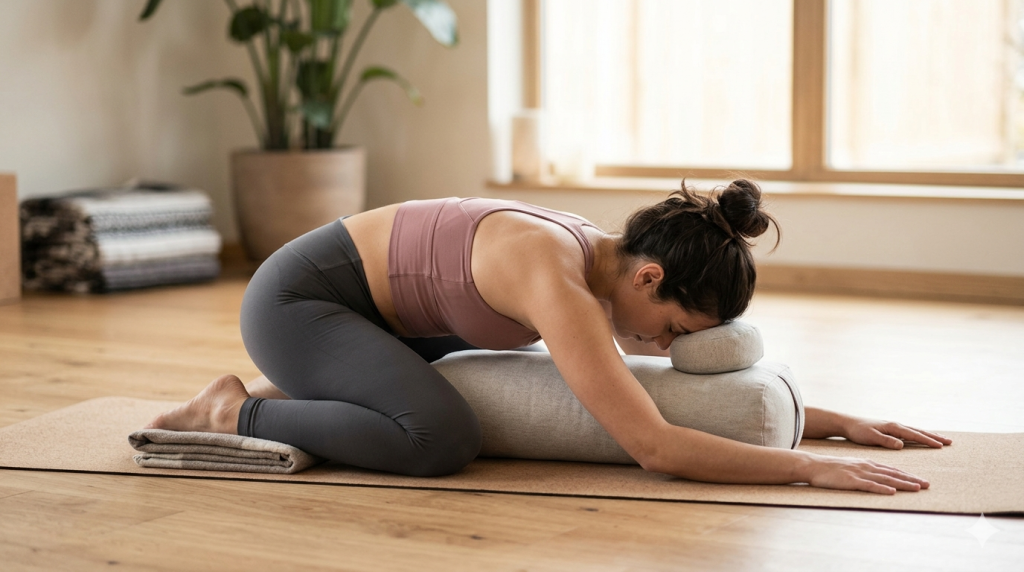
Child’s Pose (Balasana) is often introduced in yoga classes as the “universal resting position.” Instructors frequently cue it as a safe harbor—a place to return to whenever the flow becomes too intense or your breath begins to ragged. However, for many practitioners, Child’s Pose is anything but restful. If you struggle with tight hips, stiff ankles, or knee discomfort, forcing yourself into this “simple” fold can feel like a chore rather than a relief.
The truth is that human anatomy varies wildly. A pose that feels like a warm embrace for one person can feel like a mechanical bottleneck for another. If Child’s Pose feels inaccessible, you aren’t “doing it wrong”; your body is simply asking for a different approach. By understanding the mechanics of the pose and utilizing smart modifications, you can transform this foundational stretch into the restorative tool it was meant to be.
Why Child’s Pose Isn’t Always Easy
To make Child’s Pose work for you, it helps to understand why it might be difficult in the first place. The pose requires significant flexion in three major areas: the knees, the hips, and the ankles. It also demands a degree of spinal extension and shoulder mobility if you are reaching your arms forward.
Knee Compression: Deeply bending the knees can be stressful for those with past injuries or naturally tight joints.
Hip Mobility: If your hip flexors or glutes are tight, your sit bones may hover far above your heels, creating a sense of instability.
Ankle Flexibility: Resting the tops of the feet flat on the floor (plantar flexion) can cause cramping or sharp pain if your ankles are stiff.
Body Proportions: For individuals with larger chests or bellies, the traditional “knees together” version of the pose can feel restrictive for breathing.
Essential Modifications for Every Body
You don’t need to suffer through discomfort to reap the benefits of Balasana. Here are the most effective ways to customize the pose using common yoga props or household items like pillows and towels.
1. The Wide-Knee Variation (Better for Breathing)
Instead of keeping your thighs touching, bring your big toes together and spread your knees as wide as the yoga mat. This creates a “well” for your torso to sink into. This version is often much more comfortable for those who feel claustrophobic in the pose or find that their stomach or chest gets in the way of a deep fold. It also shifts the stretch more into the inner thighs and adductors.
2. Elevating the Hips (For Tight Knees and Hips)
If your hips don’t reach your heels, gravity can pull on your lower back in an uncomfortable way.
The Fix: Fold a Mexican yoga blanket or a firm towel and place it in the “nook” behind your knees before you sit back. This reduces the angle of knee flexion and provides a physical bridge between your glutes and your heels. You can also place a bolster or a thick pillow between your thighs to sit on.
3. Support for the Forehead (For Neck Strain)
If your head doesn’t reach the floor comfortably, your neck muscles will stay “on” to support the weight of your skull, preventing total relaxation.
The Fix: Place a yoga block, a stack of books, or even your stacked fists under your forehead. When the forehead is firmly supported, the nervous system receives a signal that it is safe to relax, helping to lower cortisol levels.
4. Ankle Relief (For “Foot Cramps”)
If the tops of your feet hurt when pressed against the mat, you likely have tight shin muscles or ankles.
The Fix: Roll up a small towel and place it underneath your ankles so they aren’t forced into a completely flat position. This slight elevation removes the “pulling” sensation on the front of the foot.
The Benefits of Getting It Right
When you find your “Goldilocks” version of Child’s Pose—the one that is just right—the physiological benefits are immense:
Decompresses the Lower Back: By rounding the spine slightly and allowing the hips to sink, you create space between the vertebrae in the lumbar spine.
Calms the Nervous System: The gentle pressure on the forehead (the “third eye” area) is known to stimulate the vagus nerve, transitioning the body from “fight or flight” to “rest and digest.”
Improved Digestion: The gentle compression of the abdomen against the thighs can massage the internal organs, aiding in digestion and relieving bloating.
Mindfulness and Grounding: Because the pose turns your gaze inward and limits external visual stimuli, it is an excellent posture for practicing deep, diaphragmatic breathing.
Beyond the Physical: The Mental Shift
In Western fitness culture, we are often conditioned to believe that “no pain, no gain” is the path to progress. Yoga invites a different philosophy: Ahimsa, or non-violence. Forcing your body into a shape it isn’t ready for is a form of internal friction.
Making Child’s Pose work for you is an exercise in body autonomy. It’s about listening to the biofeedback your joints are providing and responding with compassion. When you use a prop, you aren’t “cheating”; you are optimizing your environment so your body can actually achieve the intended physiological state of the pose.
Conclusion
Child’s Pose is a tool, not a test. Whether you use three bolsters and two blankets or simply widen your knees, the goal remains the same: to find a moment of stillness and release. Next time you’re in a class and the teacher calls for Balasana, don’t feel obligated to follow the “textbook” version. Reach for your props, adjust your alignment, and make the pose serve you.
Frequently Asked Questions (FAQ)
Q: Should my heels always touch my glutes in Child’s Pose? A: Not necessarily. While this is the “final” expression of the pose, many people have anatomical skeletal limits or muscle tightness that prevents this. Using a blanket between the thighs and calves is a perfect solution.
Q: Why does my lower back hurt during this stretch? A: This often happens if your hips are hanging in the air without support. If the hips aren’t grounded, the lower back muscles may tense up to hold you in place. Use props to fill the gap between your heels and sit bones.
Q: Can I do Child’s Pose if I have a knee injury? A: It depends on the injury. If deep bending (flexion) causes sharp pain, you should avoid the traditional version. You might try “Puppy Pose” (Anahatasana) instead, which keeps the hips stacked over the knees while the chest melts toward the floor, providing a similar upper-body stretch without the knee compression.
Q: My arms get tired when I reach them forward. What should I do? A: Simply reach your arms back toward your feet, palms facing up. This allows the shoulder blades to spread apart and lets the tops of the shoulders melt toward the mat, offering a different but equally beneficial release for the upper back.
Q: How long should I stay in the pose? A: For general relaxation, 30 seconds to a minute is great. In restorative yoga, practitioners may stay in a supported Child’s Pose for 5 to 10 minutes to allow the fascia and deeper connective tissues to release.