In the landscape of longevity and healthy aging, we often prioritize heart health, cognitive function, and muscle mass. However, a physical therapist warns that one of the most overlooked “red flags” for long-term mobility is actually located much lower: your ankles.
According to Dr. Jamie Bovay, founder of KinetikChain Denver, poor ankle mobility is a primary driver of falls and balance issues later in life. While it may seem like a minor stiffness today, restricted range of motion in the ankle can set off a chain reaction of instability that impacts the knees, hips, and lower back.
The Hidden Crisis of Ankle Stiffness
As we age, many people attribute loss of balance to “getting old” or a natural decline in coordination. In reality, the culprit is often mechanical. The ankle joint—specifically its ability to perform “dorsiflexion” (the movement where the top of the foot moves toward the shin)—is critical for nearly every functional movement.
Whether you are navigating uneven terrain on a morning walk, descending a flight of stairs, or simply getting up from a chair, your ankles act as the primary shock absorbers and stabilizers. When this joint becomes immobile, the body loses its ability to adapt to the ground beneath it.
Why Do Our Ankles Stiffen?
Dr. Bovay points out two main reasons for this modern epidemic of stiff ankles:
The Footwear Trap: Most modern shoes feature a slightly elevated heel. Even a small drop from heel to toe keeps the Achilles tendon and calf muscles in a shortened state for hours a day. Over time, these tissues lose their elasticity.
Lack of Diverse Movement: We spend most of our time walking on flat, paved surfaces. Without the need to flex and rotate on varied terrain, the nervous system essentially “forgets” how to access the full range of motion.
When the ankle is stiff, the body compensates by shifting the stress upward. This is why chronic knee pain or lower back stiffness often cannot be resolved without first addressing the ankles.
The 3-Step Protocol to Reclaim Your Balance
To combat these issues, physical therapists recommend a “Test and Treat” approach. If you find yourself tripping more often or feeling unsteady on stairs, these three evidence-based exercises can help remodel your joint health.
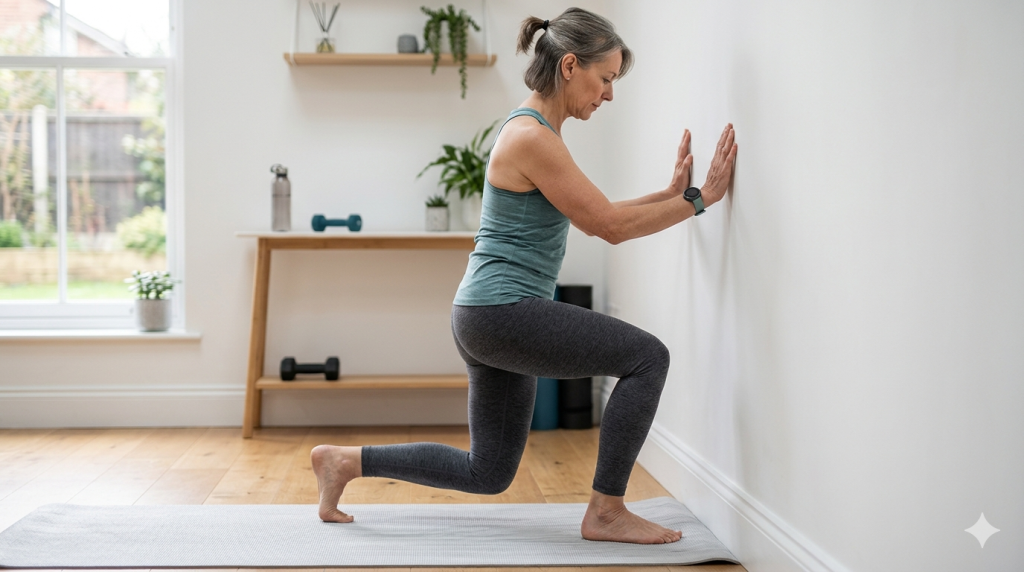
1. Knee-to-Wall Mobilization (The Joint Glide)
This is a “closed-chain” functional movement. Unlike a passive stretch, it forces the talus bone (the bone connecting the foot to the leg) to glide backward.
How to do it: Stand facing a wall in a staggered stance. Your target foot should be forward, toes about 2-3 inches from the wall.
The Move: Keeping your heel firmly on the floor, slowly drive your knee forward until it touches the wall.
The Goal: Do not let the heel lift. If it’s easy, move your foot back another inch and repeat.
Frequency: 2-3 sets of 12-15 reps per side.
2. Eccentric Calf Drops (Tissue Remodeling)
Research shows that “eccentric” loading—the process of lengthening a muscle under tension—is the gold standard for strengthening the Achilles tendon and increasing flexibility.
How to do it: Stand with the balls of your feet on the edge of a step, heels hanging off.
The Move: Rise up on your toes with both feet, then slowly (count to 3) lower your heels below the level of the step.
Why it works: This doesn’t just stretch the muscle; it builds “structural armor” in the tendon to prevent injury.
Frequency: 3 sets of 10 reps.
3. Tibialis Anterior Raises (The Strength Connector)
Mobility is useless without the strength to control it. The tibialis anterior is the muscle on the front of your shin responsible for pulling your toes up.
How to do it: Lean your back against a wall with your feet about 12 inches away from the base.
The Move: Keeping your legs straight, pull your toes up toward your shins as high as possible. Hold for a second, then lower.
The Benefit: Strengthening this muscle prevents “toe-catching,” a common cause of trips and falls among seniors.
Frequency: 2 sets of 20 reps.
The Science of Falls: A Kinetic Chain Reaction
Falls are the leading cause of injury-related visits to emergency rooms for adults over 65. From a biomechanical perspective, a fall is often the result of a “stiff” joint failing to absorb force. When you trip, your brain sends a signal to your ankle to quickly flex and catch your weight. If the ankle joint is locked or the shin muscle is weak, that “catch” never happens, and the center of gravity shifts too far forward.
By restoring dorsiflexion, you provide your body with a wider “margin of error.” You can step deeper into a squat or recover from a stumble much faster.
Implementing Ankle Mobility into Daily Life
You don’t need a gym to improve your balance. Physical therapists suggest “habit stacking”—doing your tibialis raises while waiting for coffee to brew or performing knee-to-wall stretches while on a phone call.
Furthermore, consider spending more time barefoot or in “zero-drop” footwear when at home. This allows the Achilles tendon to return to its natural length and encourages the small muscles in the feet to engage.
Conclusion: It’s Never Too Late
The good news is that mobility is not a “use it or lose it” trait that disappears forever. The human body is remarkably adaptable. Even if you have dealt with stiff ankles for decades, consistent eccentric loading and mobilization can significantly reduce your risk of falls and improve your quality of life.
Investing 10 minutes a day in your ankles is an investment in your independence for the decades to come.
FAQ: Frequently Asked Questions
Q: How do I know if my ankle mobility is “poor”? A: Try the “5-inch wall test.” Place your toes 5 inches from a wall and try to touch your knee to the wall without your heel lifting. If you can’t reach the wall, your mobility is restricted.
Q: Can these exercises help with plantar fasciitis? A: Yes. Many cases of plantar fasciitis are caused by tight calves and restricted ankles pulling on the fascia of the foot. Eccentric calf drops are often a prescribed treatment for this condition.
Q: Is it safe to do these if I’ve had an old ankle sprain? A: Generally, yes. In fact, old sprains often leave behind scar tissue that causes the very stiffness we are trying to fix. However, always consult with a doctor if you feel sharp, stabbing pain during the movements.
Q: How long until I see results in my balance? A: Most people notice an improvement in “joint feel” within 2 weeks of daily practice. Tissue remodeling (changing the actual length of the tendon) typically takes 6 to 12 weeks of consistent training.