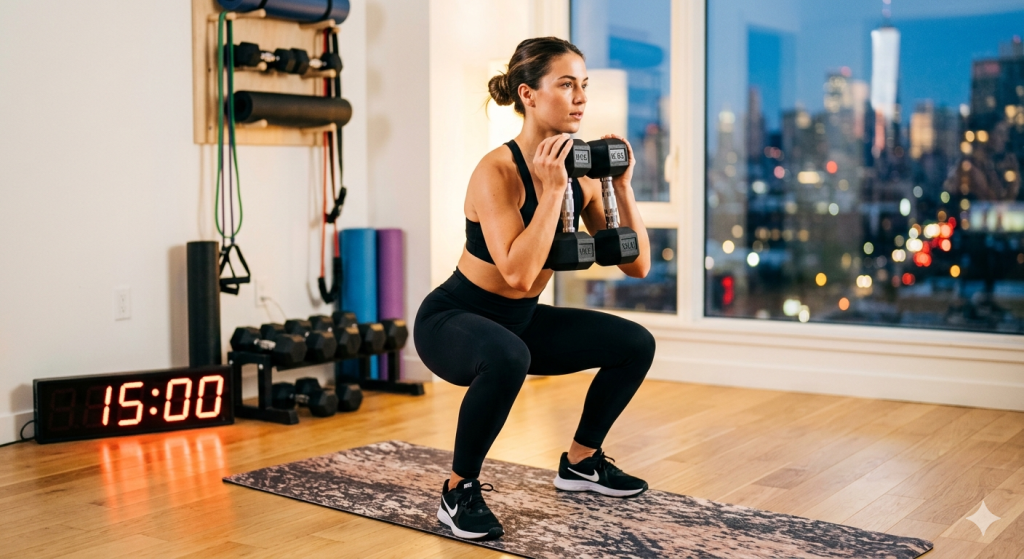
In a world where “no time” is the most common excuse for skipping the gym, the fitness landscape is shifting toward efficiency. You don’t need a sprawling commercial gym or a two-hour block of time to see real physiological changes. Recent trends in sports science suggest that high-intensity, short-duration resistance training can be just as effective for metabolic health and muscle maintenance as longer sessions.
If you have a set of dumbbells and 15 minutes, you have everything you need to transform your physique. This guide breaks down a high-yield workout designed to maximize every second you spend under tension.
The Science of the 15-Minute Stimulus
Many fitness enthusiasts believe that if they can’t spend an hour lifting, it isn’t worth doing. However, the “all-or-nothing” mentality is the enemy of consistency. Short, intense bouts of exercise utilize Hypertrophy-Specific Training (HST) principles by focusing on mechanical tension and metabolic stress.
By utilizing compound movements—exercises that involve multiple joints and muscle groups—you increase your caloric burn and hormonal response. This 15-minute routine isn’t just a “filler” workout; it is a strategic strike against muscle atrophy and a boost for your basal metabolic rate.
The Essential Equipment: Choosing Your Dumbbells
To make this 15-minute session work, your equipment must match your goals.
For Hypertrophy (Muscle Growth): Choose a weight where you struggle to maintain perfect form by the 10th or 12th rep.
For Strength: Lean toward heavier weights with lower rep ranges (5–8 reps).
For Endurance: Lighter weights with higher volume (15+ reps).
If you are working out at home, adjustable dumbbells are a game-changer, allowing you to pivot between exercises like lateral raises (light) and goblet squats (heavy) without losing time.
The 15-Minute Full-Body Blueprint
This workout follows a Circuit Training format. Perform each exercise for 45 seconds, followed by 15 seconds of rest. Complete the entire circuit three times.
1. The Goblet Squat (Quads, Glutes, Core)
Hold one dumbbell vertically against your chest, cupping the top head with both hands. Keep your elbows tucked in.
The Move: Drop your hips back and down as if sitting in a chair. Keep your chest up and drive through your heels to return to a standing position.
Why it works: It forces core engagement while torching the largest muscle groups in your body, sparking a significant thermogenic effect.
2. Dumbbell Overhead Press (Shoulders, Triceps)
Stand with feet shoulder-width apart, holding dumbbells at shoulder height with palms facing inward (neutral grip) or forward.
The Move: Press the weights toward the ceiling until your arms are fully extended, then slowly lower them back to the starting position.
Pro Tip: Avoid arching your back. Squeeze your glutes to create a stable “pillar” for the lift.
3. Bent-Over Rows (Back, Biceps, Rear Delts)
Hinge at the hips until your torso is nearly parallel to the floor, keeping a slight bend in your knees. Let the dumbbells hang at arm’s length.
The Move: Pull the dumbbells toward your ribcage, squeezing your shoulder blades together at the top.
Why it works: This counters the “hunch” many of us develop from sitting at desks, improving posture and back thickness.
4. Dumbbell Lunges (Hamstrings, Glutes, Balance)
Hold a dumbbell in each hand at your sides.
The Move: Step forward with one leg and lower your hips until both knees are bent at 90-degree angles. Push back to the start and switch legs.
Focus: Maintain an upright torso to put the emphasis on the legs rather than the lower back.
5. Floor Press or Push-Ups (Chest, Triceps)
If you have a bench, use it; otherwise, the floor press is an excellent way to build chest strength without straining the shoulders.
The Move: Lie on your back with knees bent. Press the dumbbells up from your chest. The floor acts as a safety stop, preventing your elbows from dropping too far.
Maximizing the “Discover” Factor: Nutrition and Recovery
A 15-minute workout is only half the battle. To truly see results that “pop” on social media or in the mirror, your recovery must be on point.
Protein Synthesis: Aim for 0.7g to 1g of protein per pound of body weight to repair the micro-tears created during your dumbbell session.
Hydration: Water is essential for nutrient transport. Even slight dehydration can decrease strength output by up to 10%.
Active Recovery: On days you don’t do this 15-minute circuit, focus on low-intensity movement like walking or yoga to keep blood flowing to healing tissues.
Conclusion: Consistency Over Intensity
The secret to the 15-minute dumbbell workout isn’t what happens in those 900 seconds—it’s that those 900 seconds actually happen. Fitness is a marathon, not a sprint. By removing the barrier of “time,” you create a sustainable habit. Whether you are in a hotel room, a garage, or a small apartment, these five moves will ensure you stay on track with your strength and aesthetic goals.
Frequently Asked Questions (FAQ)
Q: Can I really build muscle in only 15 minutes? A: Yes. Research shows that high-intensity resistance training, even in short durations, triggers muscle protein synthesis. The key is to use weights heavy enough to reach near-failure within the time frame.
Q: How many times a week should I do this routine? A: For beginners, 3 times a week is ideal. More advanced lifters can use this as a daily “maintenance” routine or perform it 5 times a week, alternating intensity levels.
Q: What if I only have one dumbbell? A: No problem. Simply perform the reps on one side for 45 seconds, then switch to the other side during the next interval or the next round. Single-sided (unilateral) training is actually superior for core stability.
Q: Is this workout suitable for weight loss? A: Absolutely. Strength training builds muscle, and muscle tissue burns more calories at rest than fat tissue. This “afterburn” effect (EPOC) keeps your metabolism elevated long after the 15 minutes are over.
Q: Should I do cardio as well? A: While this circuit provides a cardiovascular challenge, adding a 20-minute walk on off-days or after the workout can further improve heart health and fat loss.