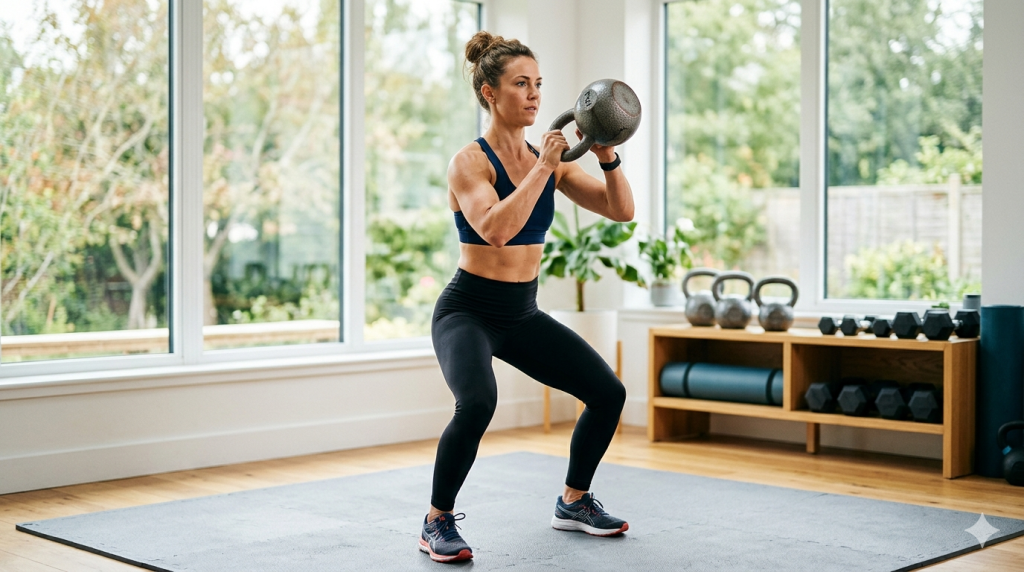
Forget the repetitive treadmill grinds and the static weight machines. If you’re looking to shatter plateaus and build a body that’s as functional as it is aesthetic, the secret lies in the “flow.” A top strength specialist reveals the four transformative kettlebell movements that challenge your coordination and torch calories like never before.
In the modern fitness landscape, consistency is the ultimate currency. But let’s be honest: doing the same three sets of ten every week is a recipe for mental burnout. Melora Storm, a premier strength and HIIT coach at Chelsea Piers Fitness, believes the antidote to gym boredom is dynamic movement. By looping exercises together into a seamless “flow,” you don’t just build muscle—taming the kettlebell becomes a mental puzzle that keeps you engaged from the first rep to the last.
Whether you’re a seasoned lifter or looking to transition from dumbbells to something more versatile, these four moves are designed to hit every major muscle group while bulletproofing your joints.
1. The Goblet Clean to Halo: 360-Degree Mobility
Traditional lifting often moves in just one plane. The Goblet Clean to Halo breaks that mold, forcing your body to rotate and stabilize simultaneously.
Why it works: This move is a masterclass in shoulder and hip health. The “clean” builds lower-body power, while the “halo” (circling the weight around your head) demands incredible core tension and shoulder flexibility.
Target Muscles: Deltoids, lats, glutes, quads, and the rotator cuff.
Pro Tip: As the kettlebell circles your head, keep it as close to your neck as possible. Don’t let the weight pull your ribcage forward; stay “braced” like someone is about to punch you in the gut.
2. Lateral Lunge Clean to Curtsey Lunge: The Lower-Body Architect
Most people only train moving forward and backward. This combo forces you to move laterally (side-to-side), which is essential for athletic performance and preventing knee injuries.
Why it works: The lateral lunge targets the inner and outer thighs, while the curtsey lunge hits the glute medius—the muscle responsible for hip stability. Adding a “clean” in the middle forces your legs to generate explosive force to bring the weight back to center.
Target Muscles: Abductors, adductors, glutes, and hamstrings.
The Feel: You’ll feel a deep stretch in the lateral lunge followed by a powerful “burn” in the glutes during the curtsey.
3. Half-Kneeling Clean and Press: The Core Stabilizer
Taking the legs out of the equation (by kneeling) might sound easier, but it’s actually a trap. Without the ability to “bounce” with your knees, your upper body and core have to do 100% of the work.
Why it works: The half-kneeling position is a “truth-teller.” If your core is weak, you’ll wobble. Pressing from this position builds “pure” overhead strength and forces your obliques to fire to keep you upright.
Target Muscles: Shoulders, triceps, obliques, and chest.
Execution Note: Focus on “punching” the weight toward the ceiling. Your bicep should end up right next to your ear at the top of the movement.
4. Single-Arm Kettlebell Swing: The King of Power
The swing is the heart of kettlebell training. By using only one arm, you add a “rotational” challenge. The weight wants to pull you to one side; your job is to stay perfectly centered.
Why it works: This is the ultimate “posterior chain” builder. It develops explosive power in the hips, which translates to running faster, jumping higher, and protecting your lower back.
Target Muscles: Hamstrings, glutes, lower back, and grip strength.
Key Reminder: This is a hinge, not a squat. Think of your hips like a slingshot: pull them back, then snap them forward.
How to Scale Your Progress
To see real results, you must apply progressive overload. Melora Storm suggests two ways to level up once you’ve mastered the form:
Intermediate (The Interval Method): Perform each move for 40 seconds, then rest for 20 seconds. Complete 5 full rounds.
Advanced (The AMRAP Challenge): Set a timer for 15 minutes. Complete as many rounds as possible (AMRAP) with perfect form. If you can breeze through 5+ rounds, it’s time to grab a heavier bell.
Conclusion: Why the Kettlebell Wins
Unlike dumbbells, which have a balanced center of mass, a kettlebell’s weight is offset. This requires more “stabilizer” muscles to fire, giving you a more “complete” workout in less time. By integrating these four expert moves, you aren’t just exercising; you’re teaching your body to move as a single, powerful unit.
FAQ: Frequently Asked Questions
Q: What weight should I start with? A: For these complex moves, form is priority #1. Most active women find success starting with an 18lb (8kg) or 26lb (12kg) bell. Active men usually start between 26lb (12kg) and 35lb (16kg).
Q: Can I do this workout every day? A: Because these are high-intensity compound movements, your central nervous system needs rest. Aim for 3 to 4 times a week, allowing at least 24 hours between sessions for muscle repair.
Q: Will kettlebell training make me “bulky”? A: No. Kettlebell training is more focused on “lean mass” and cardiovascular endurance. It builds a dense, athletic physique rather than the “swollen” look associated with heavy bodybuilding.
Q: What if I have lower back pain? A: Most back pain during kettlebell moves comes from “squatting” the swing or rounding the spine. Focus on the hip hinge (pushing your butt back toward a wall). If pain persists, consult a physical therapist before continuing.