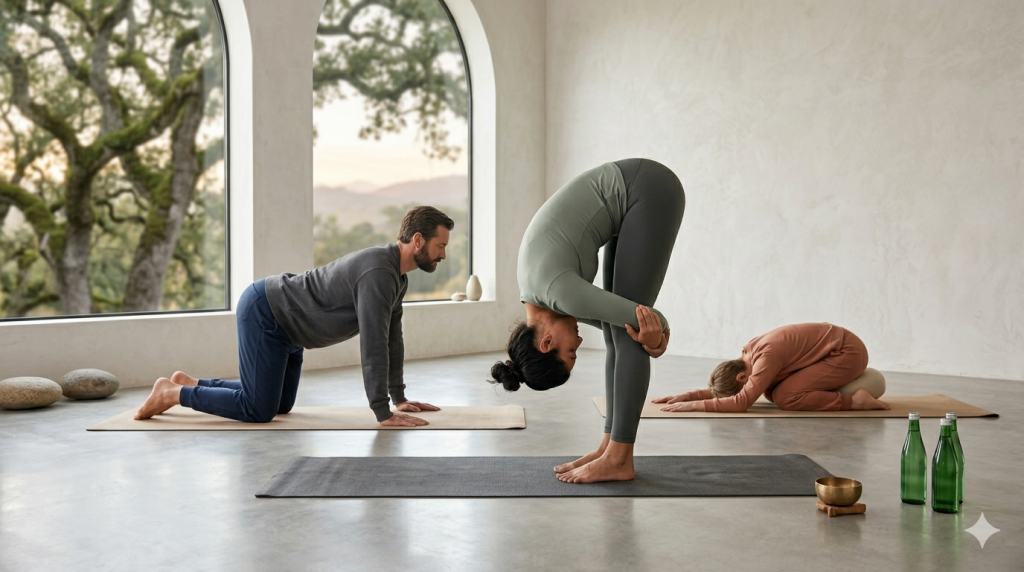
As workplace stress reaches record highs across the United States, a new movement in wellness is gaining traction. Forget the 90-minute studio session—new clinical insights suggest that “Micro-Yoga,” a targeted 10-minute intervention, might be the most effective tool yet for immediate nervous system regulation and mental clarity.
The Rising Epidemic of “Always-On” Stress
In a hyper-connected 2026 landscape, the average American worker spends over eight hours a day in a state of “high-alert” sympathetic nervous system activation. Between back-to-back video calls and the relentless pace of digital notifications, the human brain rarely finds the “off switch.”
Recent data from the American Psychological Association (APA) suggests that chronic stress is no longer just a mental health concern; it is a physical crisis. However, the barrier to entry for traditional exercise is often time. This is where the 10-minute stress-relief break—specifically focusing on three restorative yoga poses—is proving to be a game-changer for office workers and stay-at-home parents alike.
[Image: A professional in a modern home office setting taking a 10-minute yoga break]
The Science of the “Micro-Break”
Why 10 minutes? Neurologists point to the Vagus Nerve, the longest nerve of the autonomic nervous system, which controls your body’s ability to relax. Short, targeted movements combined with conscious breathing can “flip the switch” from the “fight-or-flight” response to the “rest-and-digest” state almost instantly.
“We are seeing a shift in how people view fitness,” says a leading wellness consultant based in New York. “It’s no longer just about calories burned; it’s about cortisol managed. Ten minutes of strategic yoga doesn’t just stretch the muscles—nurtures the brain.”
Three Essential Poses to Reset Your Nervous System
You don’t need a mat, a change of clothes, or a dedicated studio space. These three poses are selected for their high “Return on Investment” (ROI) regarding physical tension and mental calm.
1. The Standing Forward Fold (Uttanasana) – The Brain Booster
This pose is a powerful way to reverse the blood flow and calm the mind. By letting the head hang below the heart, you encourage a rush of oxygenated blood to the brain.
How to do it: Stand with feet hip-width apart. Exhale and hinge at your hips. Let your arms hang or grab opposite elbows.
The Benefit: It physically releases tension in the hamstrings and lower back—areas where we hold stress from sitting—while mentally providing a “reset” for the visual cortex by changing your perspective.
2. The Cat-Cow Flow (Chakravakasana) – The Spinal Decompressor
Most stress-related pain manifests in the neck and spine. The Cat-Cow flow is a rhythmic movement that synchronizes breath with motion, a key component in reducing anxiety.
How to do it: Start on hands and knees. Inhale as you drop your belly and look up (Cow). Exhale as you arch your back and tuck your chin (Cat).
The Benefit: This move massages the spine and stimulates the kidneys and adrenal glands, which are responsible for the body’s stress hormones.
3. Child’s Pose (Balasana) – The Ultimate Sanctuary
This is the ultimate “reset” button. It is a posture of total surrender, signaling to the brain that it is safe to let go of external stimuli.
How to do it: Kneel on the floor, sit on your heels, and fold forward, resting your forehead on the ground. Extend your arms forward or rest them by your sides.
The Benefit: By placing the forehead (the third eye center) on the floor, you stimulate the vagus nerve and promote a sense of deep, internal security.
Integrating Yoga into the Corporate Culture
Major tech hubs in San Francisco and Austin are already beginning to implement “Movement Minutes” into their daily schedules. The philosophy is simple: a 10-minute break actually increases productivity by reducing the “brain fog” associated with long-term stress.
The “Yoga at the Desk” Reality
For those who cannot leave their workstation, these poses can be adapted. A “Seated Forward Fold” or a “Seated Cat-Cow” provides nearly the same neurological benefits as the traditional versions. The key is the breath.
“Breathwork is the remote control for your brain,” explains a wellness coach. “When you pair a deep inhale with a stretch, you are literally telling your amygdala to stand down.”
Beyond the Physical: The Mindfulness Component
What sets yoga apart from simple stretching is the element of mindfulness. During these 10 minutes, the goal is to move the focus from “doing” to “being.” In a culture that prizes “hustle,” taking 10 minutes to do nothing but breathe and move is a radical act of self-care.
[Image: Close up of a person breathing deeply in Child’s Pose with soft, natural lighting]
Conclusion: Making the 10-Minute Commitment
In the grand scheme of a 24-hour day, 10 minutes is less than 1% of your time. Yet, the cumulative effect of these micro-breaks can be the difference between a productive week and total burnout. As we navigate the complexities of 2026, the most sophisticated tool in our wellness arsenal isn’t an app or a wearable—it’s our own ability to stop, breathe, and move.
FAQ: Frequently Asked Questions
Q: Do I need to be flexible to do these poses? A: Not at all. Yoga is not about touching your toes; it’s about what you learn on the way down. In a forward fold, you can bend your knees as much as needed to feel comfortable.
Q: Can I do this in my work clothes? A: Absolutely. These three poses are “office-friendly.” If you are wearing a skirt or stiff suit, the seated versions or the standing forward fold are easily manageable without needing a locker room.
Q: When is the best time of day for a 10-minute yoga break? A: While any time is good, the “mid-afternoon slump” (between 2:00 PM and 3:00 PM) is the most effective time to reset your energy and avoid reaching for a third cup of coffee.
Q: How soon will I feel the results? A: Most people report an immediate drop in heart rate and a feeling of “lightness” in the shoulders and neck after just 60 seconds of focused breathing and movement.
Q: Is 10 minutes really enough to make a difference? A: Yes. Science shows that even short bursts of movement can lower cortisol levels. Consistency is more important than duration. Ten minutes every day is more effective than one 60-minute class once a week.