For many active individuals, stiff hips feel like an inevitable tax paid for a lifetime of movement. Whether you spend your day behind a desk or your mornings hitting the pavement for a five-mile run, the hips often bear the brunt of our modern lifestyle. Even fitness professionals aren’t immune. Despite years of training others and understanding the biomechanics of the human body, many trainers find themselves battling the same nagging tightness that plagues their clients.
However, resolving hip stiffness isn’t always about a 90-minute yoga flow or a complex series of corrective exercises. Often, the solution lies in one specific, targeted movement that addresses the multifaceted nature of the hip joint. Here is why your hips feel locked and the one movement that can change everything.
Understanding the “why” behind hip stiffness
To fix the hips, we first have to understand why they get so tight in the first place. The hip joint is a ball-and-socket joint, designed for a massive range of motion—flexion, extension, abduction, adduction, and rotation. However, most of us only move our hips in one plane: the sagittal plane (forward and backward).
When we sit, our hip flexors remain in a shortened position for hours. Over time, the nervous system “re-wires” itself to recognize this shortened state as the new normal. This leads to what is commonly known as “adaptive shortening.” When you finally stand up or try to exercise, those muscles pull on the pelvis, creating that familiar sensation of being “locked up.”
Furthermore, stiffness isn’t just about the muscles being “short.” It’s often a result of lack of stability or poor joint centration. If the brain perceives that the hip joint is unstable, it will tighten the surrounding musculature as a protective mechanism. Therefore, the best solution isn’t just a passive stretch; it’s an active movement that tells the nervous system the joint is safe to move.
The game-changer: the 90/90 hip switch
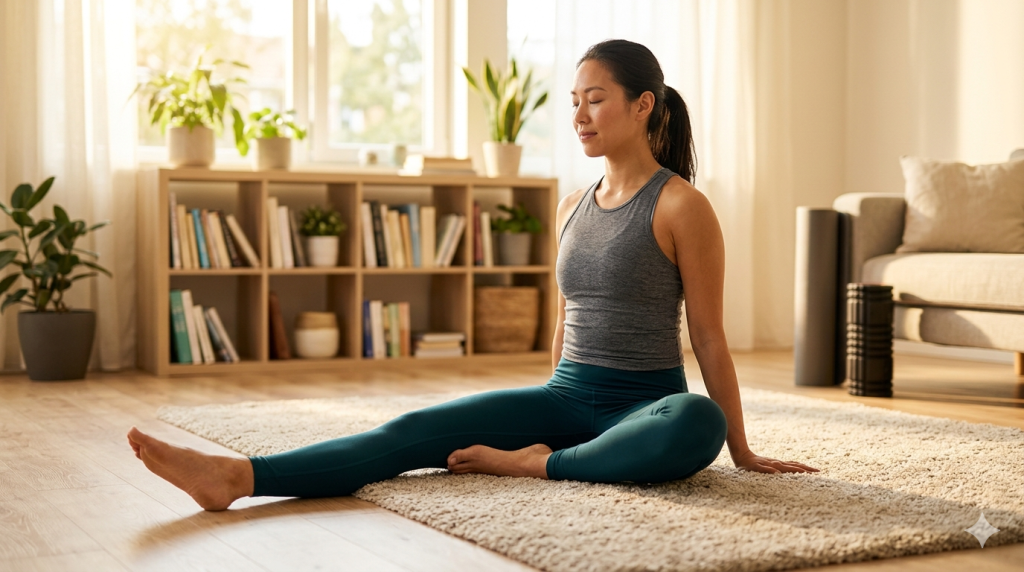
While there are dozens of stretches available, the 90/90 Hip Switch (often derived from the 90/90 position) stands out as the gold standard for restoring hip health. This move is unique because it simultaneously addresses internal rotation in one hip and external rotation in the other.
Most traditional stretches, like the pigeon pose, focus heavily on external rotation. However, a lack of internal rotation is often the hidden culprit behind lower back pain and “pinchy” hips. The 90/90 position forces the joint to work through its full rotational capacity.
How to perform the 90/90 hip switch:
The Setup: Sit on the floor with your right leg in front of you, bent at a 90-degree angle (shin parallel to your chest). Position your left leg to your side, also bent at a 90-degree angle (shin perpendicular to your body).
The Posture: Sit up as tall as possible. Try to get both “sit bones” toward the floor. You will likely feel an intense stretch in the outer right hip and the inner left hip.
The Lean: Keep your spine long and lean slightly forward over your front shin to deepen the external rotation stretch. Hold for 30 seconds.
The Switch: This is the active part. Keeping your heels glued to the floor, pivot on your heels and rotate your knees toward the left side until you are in the 90/90 position on the opposite side.
The Challenge: Try to do the switch without using your hands for support. This engages the core and forces the deep hip stabilizers to do the work.
Why this move works better than passive stretching
The reason the 90/90 switch is so effective for biohacking your mobility is that it utilizes PAILs and RAILs (Progressive and Regressive Angular Isometric Loading). By actively moving between positions, you aren’t just elongating the muscle; you are building strength at the end of your range of motion.
Strength at the end-range is the “secret sauce” for mobility. When your muscles are strong in a stretched position, your brain allows you to access that range of motion more freely because it no longer views the position as a “danger zone” for injury.
Integrating hip mobility into a busy schedule
You don’t need to spend an hour at the gym to see results. The beauty of the 90/90 switch is its efficiency. For those looking to optimize their physical longevity, consistency trumps intensity.
Morning Routine: Perform 10 controlled switches right after waking up to “wake up” the nervous system.
Work Breaks: If you work from home, drop to the floor for two minutes every time you finish a deep-work session.
Pre-Workout: Use the 90/90 as a dynamic warm-up before squats or running to ensure your glutes are firing correctly.
Conclusion
Stiff hips are a signal, not a permanent condition. By moving away from static, passive stretching and moving toward active, rotational movements like the 90/90 hip switch, you provide your body with the input it needs to move fluidly. Whether you are an elite athlete or a weekend warrior, reclaiming your hip mobility is one of the most impactful things you can do for your long-term orthopedic health.
Frequently Asked Questions (FAQ)
1. Why do my hips pop or click during the 90/90 switch? In most cases, painless popping is simply a tendon or ligament moving over a bony prominence. However, if the popping is accompanied by sharp pain, it could indicate a labral tear or impingement. Always move within a pain-free range of motion.
2. I can’t sit upright in the 90/90 position. What should I do? This is very common! If your hips are extremely tight, use your hands behind you for support. You can also sit on a yoga block or a folded towel to elevate your hips, which reduces the intensity of the angles and makes the move more accessible.
3. How long does it take to see results? Mobility is a “use it or lose it” skill. Most people feel an immediate “loosening” sensation after one session, but permanent changes in tissue length and nervous system tolerance usually take 4 to 6 weeks of consistent daily practice.
4. Can this help with lower back pain? Absolutely. The body is a kinetic chain. When the hips are immobile, the lower back (lumbar spine) often compensates by moving too much. By freeing up the hips, you allow the lower back to remain stable, which often alleviates chronic aches.